
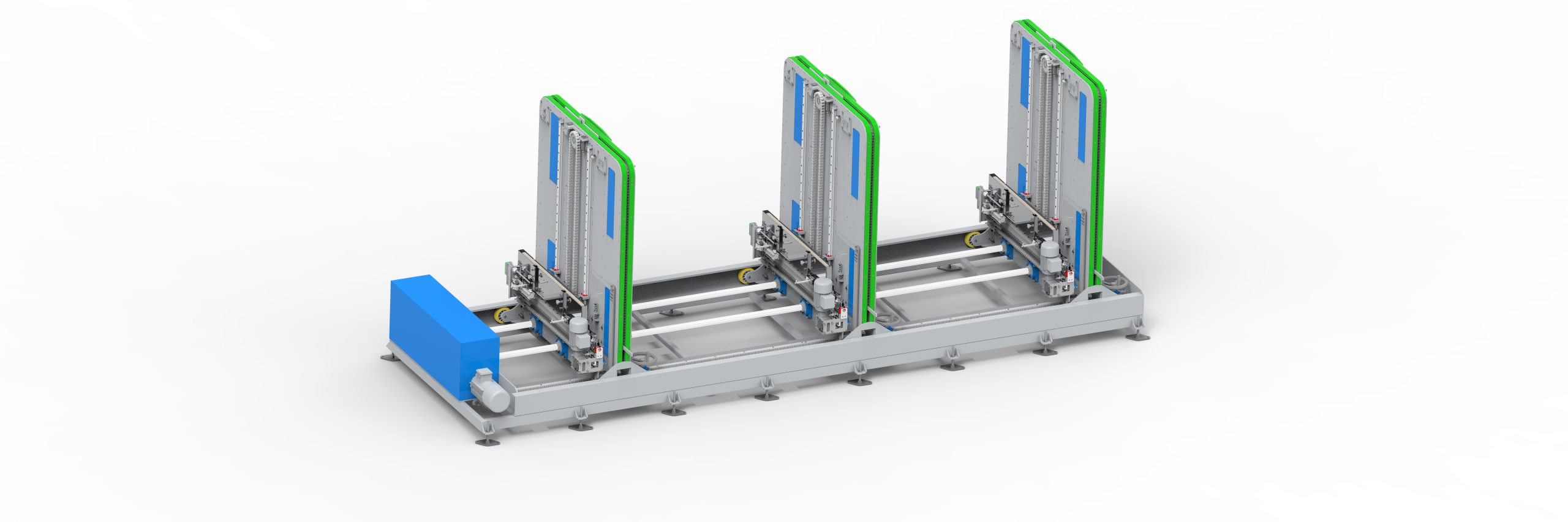
A Paternoster stacker is a fully automatic vertical stacking system designed for continuous production lines. The machine uses an endless chain equipped with carriers (paternoster principle) to gently transfer individual workpieces from the production line to the stacking section, where they are automatically assembled into bundles.
The system is intended for high-capacity handling of planed timber, boards, beams, and other wood products while minimizing product damage and reducing manual labor. The continuous vertical circulation of the carriers allows uninterrupted material flow without stopping the production line.
Main Functions
Operating Principle
Boards arriving from the planer are transferred onto the infeed conveyor. A separating mechanism (pneumatic) ensures that individual boards are picked up by the moving paternoster carrier. The carrier lifts each board to the stacking section, where cross conveyors or stacking chains transport it to the end stop, forming a complete layer.
Once the programmed number of boards has been accumulated, the stacking forks extend, transferring the layer onto the lifting platform. The lift lowers by one layer
height, and the process repeats until the required bundle height is reached. The completed bundle is then discharged automatically to the outfeed conveyor.
Typical Features
Advantages
Number of strands – stacking elements: 3 pcs
Manual adjustment accordingly to the lenght of wood
Cross feed chain motor: 4kW
Level motor: 3 kW
Forks motors: 0.75 kW x 3
Components used: Mitsubishi controller, Mitsubishi inverters, SMC pneumatics, SKF bearings, Schneider electric parts, Leuze photoelectric sensors